The Severance of the Seventeen Worlds
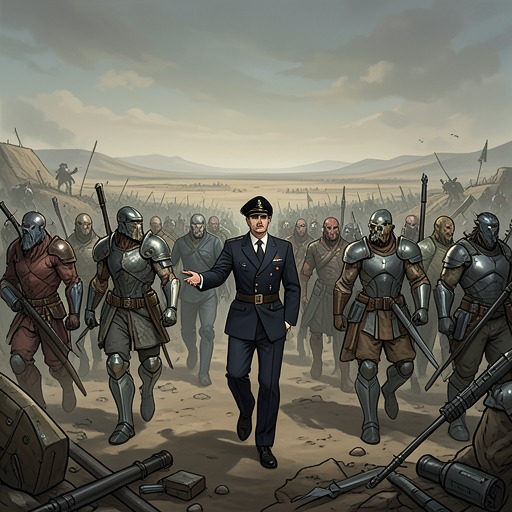
Systema Delenda EstThe Severance of the Seventeen Worlds is the campaign in which Cato converts a threatened annexation into a regional breakaway from the System. What begins as an attempt to take a single world becomes an invasion of nearly twenty worlds, because disabling the planet alone does not stop the System from opening a portal or completing the annexation. The result is both a military victory and a strategic revelation: Cato can sever a whole region from the System, but every severance leaves populations, ecosystems, digital identities, and infrastructure to survive beyond the System’s support.
Causes and Strategic Background
Cato’s wider campaign has been built on exponential industrial growth. His forces occupy hundreds of worlds, and each world supplies factories, mines, refineries, solar arrays, and local armies. Because portal travel cannot easily move large forces between worlds, he has instead cultivated independent production bases, with each planet manufacturing weapons and warframes while retaining the ability to retool its infrastructure for war. The growth is initially slow, but its accumulated scale eventually makes a simultaneous operation possible.
The immediate problem is that simply shutting down a planet is insufficient. The System can still annex the world, and the portal can still open. Cato therefore has to fight the defending forces away from the intended target and invade the surrounding region rather than treat the operation as a single-planet assault. His later explanation to Raine makes the causal chain explicit: the failed assumption about planetary shutdown forces him to confront the portal, which in turn requires a broader military diversion and produces the seventeen-world breakaway.
The System’s response reveals its hierarchy of value. The System-gods are willing to abandon the frontier worlds of Sydea and Haekos, judging them less valuable than the more developed planets farther inward. Cato’s operation exploits that preference while also exposing its limits: the frontier may be expendable in resource terms, but the Inner Worlds are too valuable to purge casually. Misse Eln later recognizes that Cato’s forces have reached every Inner World and that the frontier and the Inner Worlds are both compromised, transforming what had appeared to be scattered raids into a systemic disease.
Course of the Severance
The decisive assault is conducted with little buildup. Cato, Raine, and Leese understand that the campaign has become a blitzkrieg: simultaneous attacks, no time for prolonged negotiations, and no gradual preparation of the affected populations. Once the broader assault begins, Cato-Koh-rel drops one hundred orbit-capable warframes outside a defensive dome after an Azoth leaves. The frames scatter, detonate their specialized payloads, and launch Cato’s payloads out of the atmosphere with Orion drives, washing the area in fusion fire while the continuing assault keeps lower-rank defenders away from the blast zone.
The operation’s primary objective is completed, but Cato refuses to halt the other invasion forces wherever progress remains possible. Raine, Leese, Yaniss, and Cato’s simulations all judge that completing the campaign is preferable to leaving worlds waiting for another assault. A sudden transition into life without the System may be traumatic, but prolonged anticipation could produce fear and resentment against Cato. The public removal of just under twenty worlds therefore serves two purposes: it severs the region and demonstrates that Cato possesses both the force of arms and the will to use it.
The severance also reveals the limits of digital identity. Yaniss asks whether separation will create two versions of her, and Cato explains that there will be one version for each world unless she reconciles somewhere outside the invasion area and abandons the local substrate. Yaniss chooses reconciliation. Her substrate suspends its operations, compresses her gestalt into a static package, transmits it through FungusNet, confirms receipt, and discards the condensed archive. The continuity of experience is preserved, but the procedure remains morally unsettling because some digital beings regard it as equivalent to suicide.
Cato and the sisters remain within the severed region. A world inside the isolated area lies only forty light-years from a world that remains connected to the System, close enough for Cato to establish deep-space broadcast and receiver equipment, though not close enough for conversation. The distance changes the meaning of victory: separation is immediate, while usable news arrives only after decades, and material reinforcement would require centuries or millennia. The System’s portals remain faster than any ordinary logistical response.
Consequences for Worlds and Populations
The severance removes the System’s support and exposes how much ordinary life depended on it. On Sydea, the destruction of a planetary Nexus causes towns to lose essence, lights to fail, and stores to power down. The System retreats while regions governed by ordinary physics, biology, and ecology spread across the planet. Mountains crumble or disappear, lakes become muddy plains, sudden storms appear and vanish, grasslands shift toward native life, and alien forests wither. The transformation resembles accelerated terraforming, but it is not a clean restoration: transplanted organisms often simply die, leaving scars that require years or decades and extensive biological factories to repair.
The same danger becomes more severe on Heyk, where the collapse of the System leaves the world nearly uninhabitable. Massive flora die-offs threaten oxygen levels, while the absence of native bacteria capable of decomposing alien biomatter prevents the dead material from breaking down or entering usable cycles. Cato’s post-severance work is therefore not merely military occupation. It becomes planetary remediation, with food production, atmospheric stability, decomposition, and biological recovery treated as urgent infrastructure. The inhabitants, unprepared for the transition, even try to burn grain crops rather than grow food, regarding Cato as an apocalypse despite having survived the System’s removal.
The campaign’s scale makes remediation more difficult than the fighting. Before the assault on Haekos, Cato and Leese anticipate total ecosystem collapse, including the loss of single-celled life responsible for oxygen production. The System can regulate atmospheres and ignore incompatible pressures or compositions across portals, but base reality cannot. Oceans, coasts, and altered marine systems become particular uncertainties, and the ecological consequences of removing System-imposed conditions cannot be reduced to the political language of liberation.
Strategic and Political Significance
Cato had originally imagined a gentler route: infiltrate worlds, show their inhabitants alternatives to the System, build support, and only then bring the System down. Sydea had suggested that such liberation could work, and the reactions of Raine, Leese, and Yaniss showed that people could recognize the value of life outside the System when given the opportunity. The seventeen-world severance is a forced departure from that plan. Crisis removes the time needed for preparation, and Cato’s existence becomes publicly undeniable.
The operation is consequently a victory with an explicitly sour character. It frees worlds from the System while imposing an abrupt and dangerous transition on people who did not consent to it. Cato regards the display of power as necessary if he is to persuade other populations to accept his alternative, because he needs a credible strength behind any future attempt at subversion. The breakaway is thus both liberation and intimidation: it proves that the System can be resisted, but it also proves that resistance may arrive as an overwhelming invasion.
Misse Eln’s later assessment gives the event its wider political consequence. Cato’s forces are no longer confined to opportunistic frontier attacks; they have established a presence beyond the System’s immediate reach and across every Inner World. The System can abandon distant worlds, but it cannot simply condemn every valuable world without revealing the weakness of its campaign. The severance therefore converts Cato from a regional nuisance into a strategic threat whose existence destabilizes the System’s assurances, resource priorities, and command structure.
Long-Term Meaning and Aftermath
The Seventeen-World Severance creates a geography of separated selves and delayed connection. Yaniss’s choice to reconcile demonstrates that digital life makes territorial separation an identity problem as well as a political one: the same person can become world-specific, reunite elsewhere, or be archived through a process that preserves continuity while resembling destruction. Cato’s decision to remain, like the sisters’ decision to remain, establishes the severed region as a lived experiment rather than a temporary battlefield.
Its timetable is equally decisive. The campaign across the System will take more than forty years even with little resistance, while transmissions across the nearest interstellar gap require decades and physical support would arrive only after centuries. The severance therefore does not end Cato’s war; it begins a form of warfare in which industrial growth, autonomous local production, ecological reconstruction, and information delay matter as much as direct combat. Exponential growth turns isolated worlds into a distributed military organism, while System collapse turns each victory into a reconstruction emergency.
The event’s final significance lies in that contradiction. Cato proves that the System’s territorial unity is not inviolable, yet the act of breaking it exposes the hidden dependencies that unity had concealed. Essence-powered towns, alien ecologies, portal logistics, digital substrates, and political legitimacy all fail or transform at different speeds. The severance is therefore not simply the liberation of seventeen worlds; it is the moment when Cato’s rebellion becomes a rival system of power, with the burden of proving that worlds can survive after the old one is cut away.